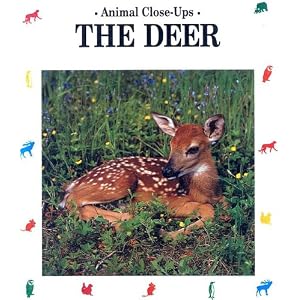
Animals Up Close: The Deer
Serge and Dominique Simon
Genre: Non-Fiction Informational
Grade Levels: 3-6
Have you ever wondered why you see deer more during a certain time of a year than you do another? Maybe you’ve wondered about baby deer, or why it is okay for people to hunt deer more than another animals? The book Animals Up Close: The Deer, provides readers with knowledge about bucks, does, and fawns and the life that they live in the forest.
The book begins with a large picture on the first page; the introduction to the buck. Even though this is an informational text, the buck is the key player in the story. First off, the book discusses the noise that the buck makes within the forest and how other bucks know it is one of them making the noise. The book then talks about how the buck's antlers make a statement to the other deer and other bucks. The antlers tell them that he is strong and powerful and should not be approached. The buck also must be able to watch the does in his group and protect them from predators, as he is the "father figure" of the family. The buck then enters the winter season and the snow creates difficulty traveling throughout the woods. This cold season is only for the strongest deer and bucks; it is difficult to make it through the whole season if you are a weak deer. Later in the season, the buck loses his antlers and begins to grow a new pair. Springtime arrives and the buck and does begin to shed, just like dogs do. Then the fawn is then born and begins to learn how to walk along side of his mother. By summertime, the bucks antlers have grown back and the fawn has also grown into a well functioning deer as well. At the very end of the book, it talks about hunting and the reason why people are allowed to hunt deer is because there is an over abundance of deer in the forests.
By having the book set up in the format of a story with the buck being the main 'character' so to speak, I think that the children would like to read this book because of how it is set as a story. It is not just a book with facts listed on each page; it gives organization to the book, which I believe would be easier to follow for the children. The book also has a monumental amount of real life photos to help tell the story of the buck and what it faces. The pictures are also accompanied by captions that go along with the image; giving the reader insight to what is going on in the photo. The captions and photos makes it easier to understand elements such as how the antlers fall off and how they grow back. They are also helpful to show the difference between what a buck is and what a doe is. Just being able to see that bucks have antlers and doe do not does a wonder for children to help them grasp the concept easier. Since there is text underneath the topic of the page and also text that go along with the images, I think it will excite the children because their eyes get to explore ever inch of the pages that they are reading.
The book is a non-fiction informational text which would be ideal for children to expand their knowledge on real life deer and would also be good as a resource tool for a project or paragraph on deer. Having this book in a classroom library would be very beneficial for the students to understand what a non-fiction book consists of and that the text is true because it is an information text. Not only would students be extending their vocabulary by reading this book, but they would also gain a lot of factual information that they can apply to their existing knowledge about deer. Since this book would be appropriate for grade levels 3-6, they are already using books as references and doing book reports and even some form of an essay. Not only would this book be a good addition to a class library, but the book could also be a good read aloud for an activity about how to pick out key facts out of a book an apply them to a project. What came to my mind when reading this book was having a chart created about what the children knew about deer before reading this book. Then once the book was read out loud, to make another chart about what the students learned after reading the book. This would provide insight for the students about how to apply what they read to something relevant to the book.
Massachusetts English Language Arts Frameworks that could be applied to this book: 3.1: Ask and answer questions to demonstrate understanding of a text, referring explicitly to the text as the basis for the answers. 3.4: Determine the meaning of words and phrases as they are used in a text, distinguishing literal from nonliteral language. 3.7: Explain how specific aspects of a text’s illustrations contribute to what is conveyed by the words in a story (e.g. create mood, emphasize aspects of character or setting). 5. 2 Describe the overall structure of a story, including describing how the beginning introduces the story and the ending concludes the action.

No comments:
Post a Comment