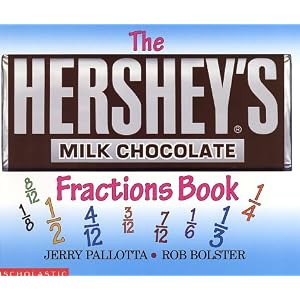
The Hershey’s Milk
Chocolate Fractions Book
Written by Jerry
Pallotta and illustrated by Rob Bolster
Appropriate for
grades 3+
If
you’re the type of person who enjoys mathematics, especially in real life
situations this book will certainly appeal to you! Find out through a variety of ways how fractions work and
when they are present in day-to-day life.
Jerry
Pallotta uses his book The Hershey’s Milk Chocolate Fractions Book to
introduce a variety of mathematical concepts to students and readers in a fun
and engaging way. Jerry begins the
book with an illustration of a wrapped Hershey’s candy bar and explains that
this is one or 1/1 chocolate bar, as the book progresses he demonstrates that
the candy bar can be broken up into 12 equal pieces, 12/12 or
twelve-twelfths. Jerry shows
students that no matter how you arrange the pieces you still have the same
amount of chocolate and then moves on to the concept of what happens when you
take some pieces away. Jerry shows
that if you take 1/12 away from 12/12 you’re left with 11/12 both through
illustrations and a subtraction number sentence. Next the book discusses the idea of equivalent fractions
showing that one half of the candy bar is also made up of 6/12, among other
examples. Throughout the book
Jerry takes “breaks” where he introduces the ideas that the book discusses
through examples other than chocolate bars. During these breaks we also learn about the history of
Hershey’s chocolate! The book
tells us that the Hershey’s factory is located in farmland areas because of the
high need for milk. We also learn
that the three main ingredients in Hershey’s chocolate are cocoa, milk and
sugar. The last mathematical
concept that the book introduces is the idea of how to put a fraction into its
lowest terms, which Jerry illustrates with pictures, numbers and division
number sentences.
The
illustrator of this book, Rob Bolster, uses whimsical characters that are drawn
and colored in conjunction with actual photos of a Hershey’s chocolate bar. The characters in this book are all
construction-type worker who work together to break the chocolate up with saws
and tools while also trying to keep the page clean. Several workers are seen throughout the pages painting
boarders on the edges and filling in the number sentences and fractions. A few times they accidentally spill
paint and track footprints throughout the pages! The illustrations help to add some comedy to the book, while
also helping the kids visualize how the candy bar is broken up into each
fraction.
This
book can be categorized under the nonfiction genre, specifically an
informational text. The book is
informational because it gives specific factual information about a topic
throughout the book. It is
organized in a way that allows readers to progress through the information in
away that lets them build on prior knowledge, both established before reading
and during the beginning of the book.
Jerry Pallotta talks about
fractions, beginning with easy to understand information; such as 12 pieces out
of 12 is one whole candy bar and progresses throughout the book working with
equivalent fractions and how to reduce fractions. In order to keep the book from getting to stale the author
does a good job of breaking up the book, which is almost entirely based on
mathematics, by adding some information about the Hershey factory and company
itself that allows readers to become even more engaged in the book. Students learn about the different
ingredients found in candy bars and where they can be found. Lastly, the
illustrations allow students to visualize the information that is presented in
the text. Not only are the
students given a real life visual that they are most likely familiar with that
is supported with words and numbers.
I
would use this book in my classroom to introduce the concept of fractions and
demonstrate to students how they work most likely at the beginning of a
unit. I would read the story aloud
to the students and potentially give them their own candy bars or manipulatives
to use while we read the story. As
an extension I would have the students look for other real life examples of
fractions and present them to their classmates. Also, I could connect this story to a reading book Chocolate
Fever by Robert Kimmel Smith if I wanted to use a thematic unit.
Massachusetts
Curriculum Frameworks used:
Grade 3 Math
Number and Operations—Fractions21 3.NF
Develop understanding of fractions as numbers.
1. Understand
a fraction 1/b as the quantity formed by 1
part when a whole is partitioned into b equal parts; understand a
fraction a/b as the quantity formed by a parts
of size 1/b.
3. Explain
equivalence of fractions in special cases, and compare fractions by reasoning
about their size.
a. Understand
two fractions as equivalent (equal) if they are the same size, or the same
point on a number line.
b. Recognize
and generate simple equivalent fractions, e.g., 1/2 = 2/4, 4/6 = 2/3. Explain why the fractions are
equivalent, e.g., by using a visual fraction model.
c. Express
whole numbers as fractions, and recognize fractions that are equivalent to
whole numbers. Examples: Express 3 in the form 3 = 3/1; recognize that 6/1 = 6; locate 4/4 and 1 at the same point of a
number line diagram.
d. Compare
two fractions with the same numerator or the same denominator by reasoning
about their size. Recognize that comparisons are valid only when the two
fractions refer to the same whole. Record the results of comparisons with the
symbols >, =, or <, and justify the conclusions, e.g., by using a visual fraction
model.
Grade 3 English Language Arts
RL 4. Determine the meaning of words and phrases as they are
used in a text, distinguishing literal from nonliteral language.

No comments:
Post a Comment