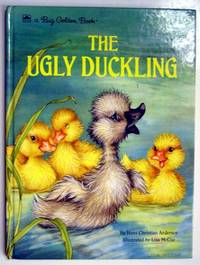
The Ugly Duckling
By Hans Christian Andersen
Illustrated by Lisa McCue
Pre-k-4
Do you love stories and books that interested you as a child? Do you want to bring back memories for you and yet instill value and messages into your students or even your own children? The Ugly Duckling by Hans Christian Andersen is a traditional story that incorporates many themes and messages into the pages.
You all known the basic story of the duckling born but was very ‘ugly’ compared to the rest of the other ducklings. Normally, at the end of most versions of this story, the duckling becomes the most beautiful of them all. Well, in this edition of The Ugly Duckling, the books starts out with many ducklings hatching from their shells and one of them is very different from the rest. Since he is so different, the other ducklings refer to him as ugly. The mother duck, has some faith that this ugly duckling will grow into a duckling just like the rest of them thought. Still, the ducklings made fun of him. Once the chicken and turkeys saw him, they too laughed at him. Eventually, this ugly duckling gets so fed up this the teasing that he runs away. The duckling ends up at a swamp, but even then, the ducks from that swamp call him ugly. The duckling then runs into a couple geese. They too think he is ugly and decide that they should take him under his wing until they hear the sounds of a gun. The two geese fly away and the ugly duckling is left alone. The duckling then flies to a near by town and goes into a cottage through a cracked window. A woman finds him and decides to keep him so that she can have fresh eggs. There the ugly duckling meets a hen and a cat. They interrogate him by asking if he can lay eggs, purr, or arch his back, and since the duckling cannot do any of these things, they make fun of him and send him on his way. The ugly duckling then gets stuck in a pong that froze over with ice, and is rescued by a man. Then man brought him home to his wife and children, but the ugly duckling causes such a scene in the house that they shoo him away. Winter then arrives and the duckling rests until the season ends. When he wakes up, the ‘ugly ducking’ feels very different then before. He flies into a pond and sees very lovely white birds. When the ugly duckling looks into his reflection in the water, he realizes that he is also one of those lovely birds. Not just a bird, but a beautiful swan. There are some children near by and cry out saying that he is the loveliest swan of them all. The swan is then overwhelmed with happiness.
This books is truly a traditional book that is appropriate to read to very young children and is also appropriate for children up to grade four or so to read. The literature and vocabulary in this edition is mature and has some words that are difficult to pronounce and the students may not know what they exactly mean. This book is great to incorporate into a classroom setting because of the many themes that appear in the book. It is great to teach students to be grateful for who they are and to teach them to accept others even if they are different. Since the animals in the book appear to be in pairs, it can also teach students about cliques and how important it is to socialize and be friendly to everyone. It can teach students about emotion and how you should not make a person feel bad for the way they look. This book can be the starting point of many different social lessons that should be taught in a classroom environment. The book is also filled with dialogue and can be used to teach how this can be incorporated in the student’s own work. Since this book falls under folklore or traditional, it is great tool to also teach how there can be many versions of different stories which originated in multiple places.
Pre K-2 With prompting and support, retell a sequence of events from a story read aloud.
1.3: Describe the connection between two individuals, events, ideas, or pieces of information in a text.
1.7 Use the illustrations and details in a text to describe its key ideas.
2.8 Identify dialogue as words spoken by characters (usually enclosed in quotation marks) and explain what dialogue adds to a particular story or poem.
3.3. Describe characters in a story (e.g., their traits, motivations, or feelings) and explain how their actions contribute to the sequence of events.

No comments:
Post a Comment