Traditional
Anansi the Spider
Written and Illustrated By: Gerald McDermott
Grade: K-2
Have you ever wanted to read about a folktale that's been told for generations upon generations? Would it be fun to read about how six brothers work together to help their father out in a time of need? Anansi the Spider by Gerald McDermott would be the perfect book for you in this case. It is a traditional literature book that tells a story about a father who gets into trouble and six brothers work together to help their father using all their skills combined.
In this book, Anansi is the name of the father and he is a spider and has six sons named; See trouble, Road Builder, River Drinker, Game Skinner, Stone Thrower, and Cushion. Anansi ends up wondering off from home and getting lost and "[falls] into trouble" and gets eaten by a fish. See Trouble quickly notices that his father is in trouble and goes to get his brothers to help Anansi out. After the brothers help out their father, Anansi finds "a great globe of light" that he wants to give to his children and asks Nyame the God of All Things the help him decide who to give it to. Nyame decide to leave it in the sky for all and ti will always be there, that great ball of light is now known as the moon.
I liked this book and felt as though it was a very good representation of traditional literature. The story has illustrations that have and African style that really give the book a feeling of tradition. This story has a lesson as well which is what is important when categorizing something as traditional literature. Also, traditional literature books sometimes explain nature. In the case of Anansi the Spider when reading the audience gets insight to how African tradition explains the reason the moon is there. The small amount of text on each page makes it easy to remember and gives it the feel of a story told generation to generation.
I would absolutely have this story in my classroom library when I start teaching. Beside the fact that it is a Caldecott winner, it also has strong morals and gives children an insight into other cultures. Also, at the young age that I would start using this story it can teach important values like teamwork. One of the things I enjoyed most about the story was the illustrations because they really brought the book to life and gave it more of a personality.
Thursday, April 26, 2012

Eric Carle Museum

Have you ever been
to the Eric Carle museum? If you have never been you should definitely make the
trip! I think it is a great place to gain an appreciation for the art in
picture books. Not
only will you be able to see Eric Carle’s work up close but you will have the
chance to see other illustrator’s work as well. If that is not reason enough,
they have an amazing bookstore that features books by Eric Carle you can’t
really find in stores anymore!
I went to the Eric
Carle Museum about a month ago and unfortunately the exhibit that usually
features Eric Carle’s work was closed for construction. Despite my bad timing,
I had an amazing time there. The
painting or mural in the photo above is in the lobby area in the museum, which
was done by Eric Carle. There is also another mural of that size next to it. It
is absolutely huge! It is amazing how an artist can make a work of art of such
magnitude. I really loved this painting because it is not typical for Eric
Carle. Usually Eric Carle’s work is done with collage and crepe paper so it was
interesting to see his work in another medium. The two galleries that were open
featured work by Kadir Nelson who illustrated Testing the Ice: A True Story about Jackie Robinson and We Are the Ship: The Story of Negro League
Baseball. Both these books are
historical fiction. The paintings by Kadir Nelson were from both those books
that he illustrated. It is amazing how different the paintings look in person.
I realized that although the photos of these paintings look amazing in the
books they are just so much more powerful in person. They are also a lot more
lifelike. Kadir Nelson’s paintings are incredibly detailed. Most of the
paintings featured baseball players and you could see every detail from the
wrinkles in the jersey to the blades of grass. It was almost as if someone just
took a photograph of that moment and put it on the wall. It seemed way to
detailed to be a painting, which is what makes Kadir Nelson’s work so amazing
to look at. By visiting this museum, I gained a lot of respect for picture
books. Before this class, I thought making a picture book is easy to do. This
class has made me realize that both the author and the illustrator put a ton of
effort into their work and are extremely talented. By going to the museum, I was able to see how much work
illustrator’s put into each painting they do. Based on the detail of those
paintings, it must have taken such a long time for Kadir Nelson to paint all of
those paintings to make those books, not to mention the fact that he also wrote
one of them. I don’t think illustrators get as much credit as they should. They
really do bring so much meaning and depth to a story. I think that going to the
Eric Carle Museum would impact my future classroom because I am going to pay
more tribute to the illustrations. I think that talking about the illustrators
is just as important as talking about the words. At the museum, I realized how
much illustrations impact the meaning of the story. It also impacted my future
classroom because I am hoping that one day I will be able to make my students
there on a field trip because I think it would be beneficial for kids to see
the art that goes into the books they read. I also learned that they have
professional development opportunities, which I think would be really great to
go to when I am an educator. There also are events in which you can meet
illustrators and hear them talk about their work. I would love to go back to
the museum and go to one of those events. Overall, going to the museum and
looking at the illustration was such a great experience for me and really
opened my eyes to how much of a work of art that an entire picture book is. The
MA ELA frameworks a trip to the museum would cover would be:
RL 1.7 Use
illustrations and details in a story to describe its characters, setting,
or events.
RI 1.7 Use the
illustrations and details in a text to describe its key ideas.
Tuck Everlasting (Fantasy)

Title:
Tuck Everlasting
Artist/Illustrator:
Natalie Babbit
Genre:
Fantasy
Suggested
Grade Level: 6-8
Do you ever think about what it
would be like to live forever? What if you never aged; you just stayed the same
age forever? Would you try to get others to do what it takes to become immortal
so you wouldn’t have to stay in seclusion?
In Tuck Everlasting
the Tuck family accidentally becomes immortal by drinking from the spring in
the wood on the edge of young Winnie Foster’s home. They stop aging and cannot
be harmed by incidents that would normally be fatal to anyone else. When the
youngest son Jesse meets Winnie in the wood after she runs away from home, they
begin to talk and eventually she finds out about how he can live forever. She
stays with the Tucks for a while and her parents are under the impression she
has been kidnapped. They allow a man who has been watching Winnie from outside
the fence to go look for her along with the constable. When Mae Tuck, the
mother, shoots the man after he says he will reveal the spring to the world at
a very expensive price, she is sentenced to death in the gallows. Since she
will not be fatally harmed by the gallows the Tucks and Winnie have to devise a
plan to help her escape and get the Tucks out of the area so as to keep the
spring a secret. They manage to escape and Jesse gives Winnie a bottle of the
spring water and tells her that she should drink it when she turns 17, his age,
and find him so they can spend forever together. It is revealed at the end that
she died two years before the epilogue and had married and had a family of her
own. She did however use the spring water…on a toad that she had saved from
becoming road kill in the very first scene of the book.
This book is a great example of fantasy because as far as we
know, there is no such thing as a spring of magic water that makes the drinker
immortal. While we know that this is probably not possible, the story seems
real because the characters and events all are realistic in that Winnie feels
frustrated and runs away just like many kids do. If something like the spring
really did exist, there would no doubt be many people searching for it in hopes
of marketing it. The world that Babbit creates is completely real in one sense,
but when you think about the Tucks and how they must live their lives, you
realize they live in a totally different world than all of the other
characters. Not only does the reader feel as though the Tucks truly exist and
are immortal, but Winnie does as well, and this influences the way the reader
regards them. She learns to care for them as her own family and the reader
begins to feel a sense of protection for them as well.
The theme of the book is up to interpretation but one theme that
runs through the book is morality. The Tucks could have easily taken the spring
as a financial blessing, but they realized that this would not only be wrong of
them to do, but it would also interrupt the flow of humanity and the earth. If
everyone could live forever the world would surely be destroyed. The man that
watches Winnie over the fence also displays the other side of the morality
theme by his intentions to market the spring water, but he faces an untimely
death almost as if to show the reader that his intentions were immoral.
There really is no point in the story that makes the reader
think that maybe the story isn’t true. It is written in a consistent way that
really depicts a family that has to suffer the life that never ends. The
setting is presented in a realistic way that makes the only fantastic element
the Tuck Family. The town and the plot and the other characters are all
realistic and really make the reader feel as though he or she is there trying
to protect the Tuck family.
MA
ELA Frameworks:
MA RL6.2 Determine
a theme or central idea of a text and how it is conveyed through particular
details; provide a summary of the text distinct from personal opinions or
judgments.
MA RL7.3 Analyze
how particular elements of a story or drama interact (e.g., how setting shapes
the characters or plot).
MA RL8.2 Determine
a theme or central idea of a text and analyze its development over the course
of the text, including its relationship to the characters, setting, and plot;
provide an objective summary of the text.
Number the Stars (Historical Fiction)

Title:
Number the Stars
Artist/Illustrator:
Lois Lowry
Genre:
Historical fiction
Suggested
Grade Level: 6-8
Like so many other kids, I find history excruciatingly boring.
Somehow reading a story about a fictional character makes it more relatable and
interesting to learn about a historical event. If you like to learn about
history this way then historical fiction is a great way to explore different
topics in history class.
Newbury Award winner, Number the Stars is a historical fiction
chapter book by Lois Lowry that tells the story of Annemarie Johansen and her
family’s attempts to help Jews during the Nazi invasion of Denmark in the
1940s. Annemarie and her family take in her best friend Ellen who is a Jew, and
they disguise her as their deceased daughter Lise. They begin to realize that
even with the disguise she is not safe and they send her to stay with
Annemarie’s Uncle Henrik who lived outside of Denmark. The story progresses
with their travels to get Ellen to a safe place and includes many true elements
of the invasion of Denmark. The story ends a few years later when the war is
over, and Annemarie is awaiting the Ellen and her family’s return, with the
Star of David necklace Ellen had left behind before the war.
This book creates a realistic sense
of what it would be like to live through the Holocaust as a family that was not
Jewish themselves but trying to assist in hiding those that were. Many elements
of the story are true events that I have heard of in history textbooks such as
using a handkerchief with rabbit blood and cocaine to lure in a search dog then
numb its sense of smell to coax it away from any Jews that may be hiding. In
the story there were also soldiers depicted patrolling the streets of
Copenhagen that were on the lookout for Jewish families. They had no respect
for any of those living in Denmark however and treated Annemarie and all the
other people of Copenhagen like less than themselves.
Throughout the story the mood is
very sullen and gloomy, however Lowry does a great job of maintaining a sense
of optimism in some of the characters at times. Although it is not a picture
book, the description in the book is written so beautifully that you can almost
picture yourself walking the streets of Copenhagen, scared of the soldiers and
hoping you’ll get to see your best friend again tomorrow. The vivid description
of the travels to Uncle Henrik’s make the reader feel nervous about being
caught smuggling Jews out of Denmark. The characters in the story are so well
developed that the reader is made to feel like he or she is actually a part of
the Johansen family and they will develop the same values those characters
have.
MA
ELA Frameworks:
MA
RL6.1 Cite textual evidence to support analysis
of what the text says explicitly as well as inferences drawn from the text.
MA RL6.3 Describe
how a particular story’s or drama’s plot unfolds in a series of episodes as
well as how the characters respond or change as the plot moves toward a
resolution.
MA RL7.8A
Interpret a literary work by analyzing how the author uses literary elements
(e.g., mood, tone, point of view, personification, symbolism).
MA RL8.3 Analyze
how particular lines of dialogue or incidents in a story or drama propel the
action, reveal aspects of a character, or provoke a decision.
Fantasy

I Will Surprise My Friend!Mo Willems
Fantasy
Pre-K-2
Fantasy
Pre-K-2
Do you like funny books with talking animal characters? Do you like to laugh while you read? Well then you should read “I Will Surprise My Friend” by Mo Willems. This cute, funny book shows the friendship between two characters, Elephant Gerald and Piggie in their attempt to have fun and surprise each other.
This book starts off with Elephant Gerald and Piggie walking by a squirrel. They are unsure of what squirrel is doing hiding behind a rock and when they ask he answers “I am going to surprise my friend!” After this occurs, Gerald and Piggie decide that they too want to surprise each other because it looked like so much fun! This ends up in a comical situation in which Gerald and Piggie are both waiting to be surprised while sitting on opposite sides of a large rock. Gerald starts to worry and Piggie gets hungry when they both get up, spooking each other to the ground! They agree that this was a bad idea and the next time they’re bored, they’ll just play tag.
This book is the type of modern fantasy that involves animals with human traits, such as walking around, talking and wearing glasses. The main characters are Piggie and Gerald, who seem to be human. They are fun, silly characters that children would love. Because they are acting like humans, it would cause children to understand that this is an imaginary story because real animals do not actual act that way. The setting of the story is unknown, and the only real information about it is that there are two rocks in the story, one small and one large, which are shown in the illustrations as well in the text. The plot goes along and the conflict arises when they two are each waiting to be surprised. You can tell by the text and the illustrations that the two friends go from confused, to worried, to scared, such as when Gerald thinks that a scary monster may be eating Piggie! The theme of this book would be friendship and humor. Even though Piggie and Gerald scared each other, they can laugh about it later and still be friends. Sometimes it’s fun to be a little silly, and I think that it is important for young children to know that. The author brings the reader into the story, making them laugh by his comical writing style. Because he gives the characters human traits, he makes them seem realistic and likeable.
I really enjoyed this book and thought that it was really funny. I usually enjoy comical books, and I think that this is one that could be enjoyed by all ages. I like the fantasy aspect of the book, and the characters have perfect human traits (friendship, worries, nervousness, fright). I would put it into my classroom library indefinitely. I think that this sort of book would make my students enjoy reading because it is so entertaining. It would be valuable because there are few words, which makes it an easy reader for many students, whereas struggling readers would be able to read it too. The illustrations make the book even better, showing the vivid emotions that the characters exhibit.
Frameworks:
RL PK.2: With prompting and support, retell a sequence of events from a story read aloud.
RL PK.3: With prompting and support, act out characters and events from a story or poem read aloud. (Because they are fun and you know how they are feeling during the story)
RL PK.6: With prompting and support, “read” the illustrations in a picture book by describing a character or place depicted, or by telling how a sequence of events unfolds. (Because the illustrations are silly and a young child would enjoy making up their own story.)
RL PK.7: With prompting and support, make predictions about what happens next in a picture book after examining and discussing the illustrations.
RL PK.3: With prompting and support, act out characters and events from a story or poem read aloud. (Because they are fun and you know how they are feeling during the story)
RL PK.6: With prompting and support, “read” the illustrations in a picture book by describing a character or place depicted, or by telling how a sequence of events unfolds. (Because the illustrations are silly and a young child would enjoy making up their own story.)
RL PK.7: With prompting and support, make predictions about what happens next in a picture book after examining and discussing the illustrations.
Where the Wild Things Are
Where the Wild Things Are
Written
and illustrated by Maurice Sendak
Genre:
Fantasy
Suggested
Grade Level: Pre-K through 2

Did
you have a crazy imagination as a child? Did you ever have a dream of a far
away land with mythical creatures? Where
the Wild Things Are shows you a look into Max’s elaborate imagination one
night when he is sent to his room for misbehaving.
The
story begins with Max in his wolf suit being naughty around his house and his
mother sends the “wild thing” up to his bedroom without supper. Max’s room grew into a forest with an
ocean awaiting Max to sail off to a fantasy world. He arrived at the place
where the wild things are. They
tried to scare little Max but he tamed them, and at once they were frightened
of him. They called him the most wild thing of all and made him king of all the
wild things. The wild things’ rumpus lasted all through the night. Amidst his
dream world, Max became lonely and wanted to be where someone loved him. He
resigned as king of the wild things and set sail waving goodbye. Max arrived
back in his bedroom where he found supper waiting for him.
I
really enjoyed Where the Wild Things Are
because of its uniqueness. The illustrations truly are incredible. I love the
pages of the wild things and Max during their “wild rumpus.” Maurice Sendak paid careful attention to the details in the story setting to keep
children engaged. Children must understand that Max starts off in a real
world then his imagination takes him to the place of the wild things. This book
captures all the aspects of fantasy. I do not think this book should be banned
from classrooms. I agree it is not appropriate for a lesson plan, but I think
it is all right for a classroom library. The language is very simple for
children to read and comprehend. Children have a very broad, unique imagination
and I would like to see what kind of made up world they could think of.
Massachusetts ELA Curriculum Frameworks:
RL 10.1 Identify differences among the common
forms of literature: poetry, prose, fiction, nonfiction (informational and
expository), and dramatic literature.
RL 12.1 Identify the elements of plot,
character, and setting in a favorite story.
Wednesday, April 25, 2012
Westward Ho, Carlotta!
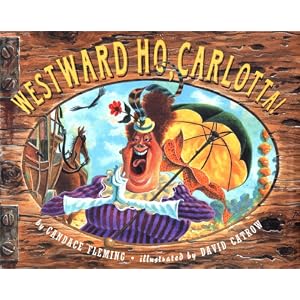
Westward Ho,
Carlotta!
Written by Candace
Fleming and Illustrated by David Catrow
Grade: 3rd
through 5th
Have you ever wondered what life was like in the Old
West? Have you ever thought about being
a sheriff or a world- renowned opera singer?
Would you ever want to travel across the country in search of adventure
in a stagecoach? In Westward Ho, Carlotta! we learn of the lifestyle of
the Old West and one woman’s dream to sing in a new part of the country to
stray from the ordinary opera houses she had previously been performing in.
In Westward Ho, Carlotta!, Carlotta is a world famous
opera singer who is tired of singing in the opera houses she normally performs
in. She decides that she wants to travel
West and sing in new parts of the country to new audiences. Along the way she wards of wolves and ends a
drought with her beautiful singing voice.
When she reaches her destination of Deadeye, North Dakota, the entire
town is waiting for her. They have heard
of all of her fabulous feats and they think she is remarkable. However, one person does not appreciate her
arrival. Skullneck Sam did not like
Carlotta one bit. He was getting ready
to fight Carlotta, however she began to sing.
He then followed to since with her and they sang a beautiful duet. The mayor of Deadeye then honored Carlotta by
naming her the new sheriff but in return to gave it to Skullneck Sam instead
and Carlotta continued on her travels westward.
This book is a good example of historical fiction and I
would keep it in my classroom library.
The illustrations are unique and very fun. It portrays the time period of the 19th
century extremely well through the use of the stagecoach to travel, the opera
houses, the clothing of the characters and the setting. The stagecoach is drawn by horses and this is
the only way that they can travel long distances west at this time period. During their journey, Carlotta and Mr.
Missouri, her chauffeur, reach Fort Larabie where they encounter soldiers. Fort Larabie is representative of Fort
Laramie, which is located in Wyoming, which was a significant destination
during the travel of the Oregon Trail at this time. The soldiers are to represent soldiers during
the Civil War which would have been occurring during this time period. The illustrations clearly depict the setting
and clothing of this time period. The
old western towns are laden with oil lamps, tiny stores and horse corals. The characters even speak of a dialect that would
have been representative in these areas at that time.
The overall plot and structure of this story
are very easy to follow and understand.
I think that this is a good story to illustrate the setting
and the people of this time period to students.
This story illustrates how opera was prevalent at this time as well as
the westward expansion. Many people were
searching for bigger opportunities because the opportunities in the east have
run dry and become old. Through the
characterization students will understand how the people of the east were much
different from the people that already moved west. British influence in clothing and style s
much different for those from the east than the cowboy clothing style that was
popular in those in the west. Students
are able to get a glimpse through history and a better sense of the westward
expansion in a fun and whimsical way through the adventures and travels of
Carlotta.
The ELA MA Curriculum Frameworks that are addressed in this
book are ELA.K-12.R.1.01. Read closely to determine what the text says
explicitly and to make logical inferences from it; cite specific textual
evidence when writing or speaking to support conclusions drawn from the text, ELA.K-12.R.1.02. Determine central ideas or themes of a text
and analyze their development; summarize the key supporting details and
ideas, ELA.K-12.R.1.03. Analyze how and why individuals, events, and
ideas develop and interact over the course of a text and RL.3.08.a. Identify elements of fiction (e.g.,
characters, setting, plot, problem, solution) and elements of poetry (e.g.,
rhyme, rhythm, figurative language, alliteration, onomatopoeia), H.5.34. Explain
the reasons that pioneer moved west from the beginning to the middle of the
19th century, and describe their lives on the frontier. (H, G, C, E),
H.5.34.a. Wagon trail journeys on the
Oregon and Santa Fe Trails.
H.5.34.b. Their settlements in
the Western territories.
Subscribe to:
Posts (Atom)